
4 November 2026
New CGL Study: What happens to unrecovered glass in residual waste?
What happens to glass packaging that is not captured for recycling? A new study from Close the Glass Loop examines the scale of unrecovered glass packaging in the European Union and estimates what happens when this material enters residual municipal waste.

The study estimates that 3.75 million tonnes of glass packaging were not recovered in the EU in 2023. This represents approximately 3.5% of all municipal waste sent to disposal.
By looking at national waste disposal strategies, glass packaging recycling performance and the use of landfill and incineration across EU Member States, the study provides new insights into where unrecovered glass is likely to go and why capturing glass through dedicated collection systems remains essential.
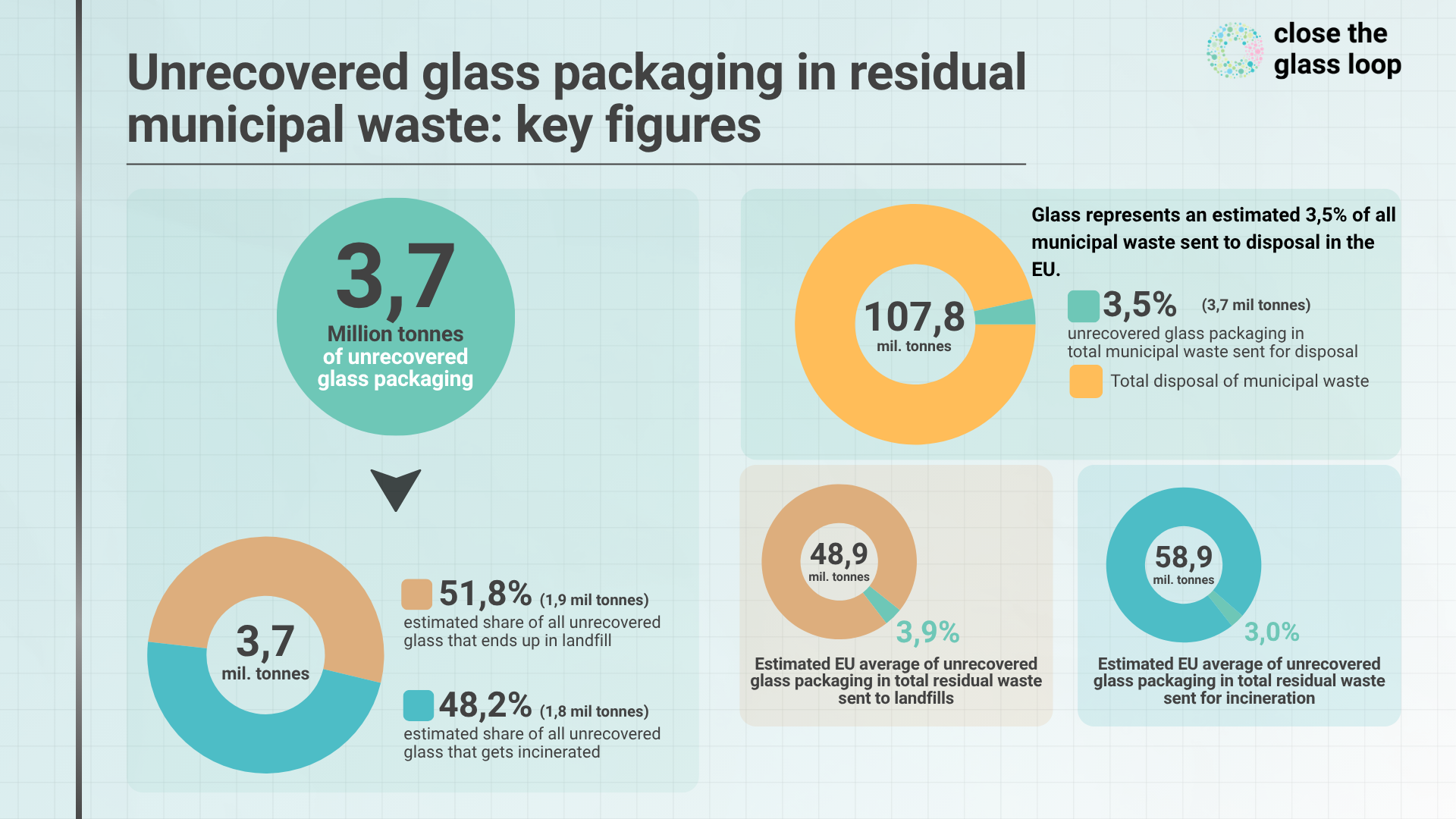
3.75 million tonnes of glass packaging remain unrecovered
In 2023, the EU glass packaging recycling rate stood at 74.9%, while the recovery rate was 75.1%. The difference between the amount of glass packaging waste generated and the amount recovered represents approximately 3.75 million tonnes of unrecovered glass packaging.
The gap between the EU glass packaging recycling and recovery rates is only 0.2 percentage points, equivalent to 29,844 tonnes. This indicates that alternative recovery routes play a very limited role for glass packaging.
Once glass packaging enters residual waste, whether it ultimately goes to landfill or incineration, it is unlikely to be recovered.
Important methodological note: For the purpose of the study, all unrecovered glass packaging is considered to enter residual municipal waste. However, some glass packaging may remain within households and may therefore not be recorded in the waste stream.
Glass represents an estimated 3.5% of residual municipal waste
Across the European Union, approximately 107.8 million tonnes of municipal waste were sent to disposal in 2023. Of this total, 58.9 million tonnes were incinerated and 48.8 million tonnes were landfilled.
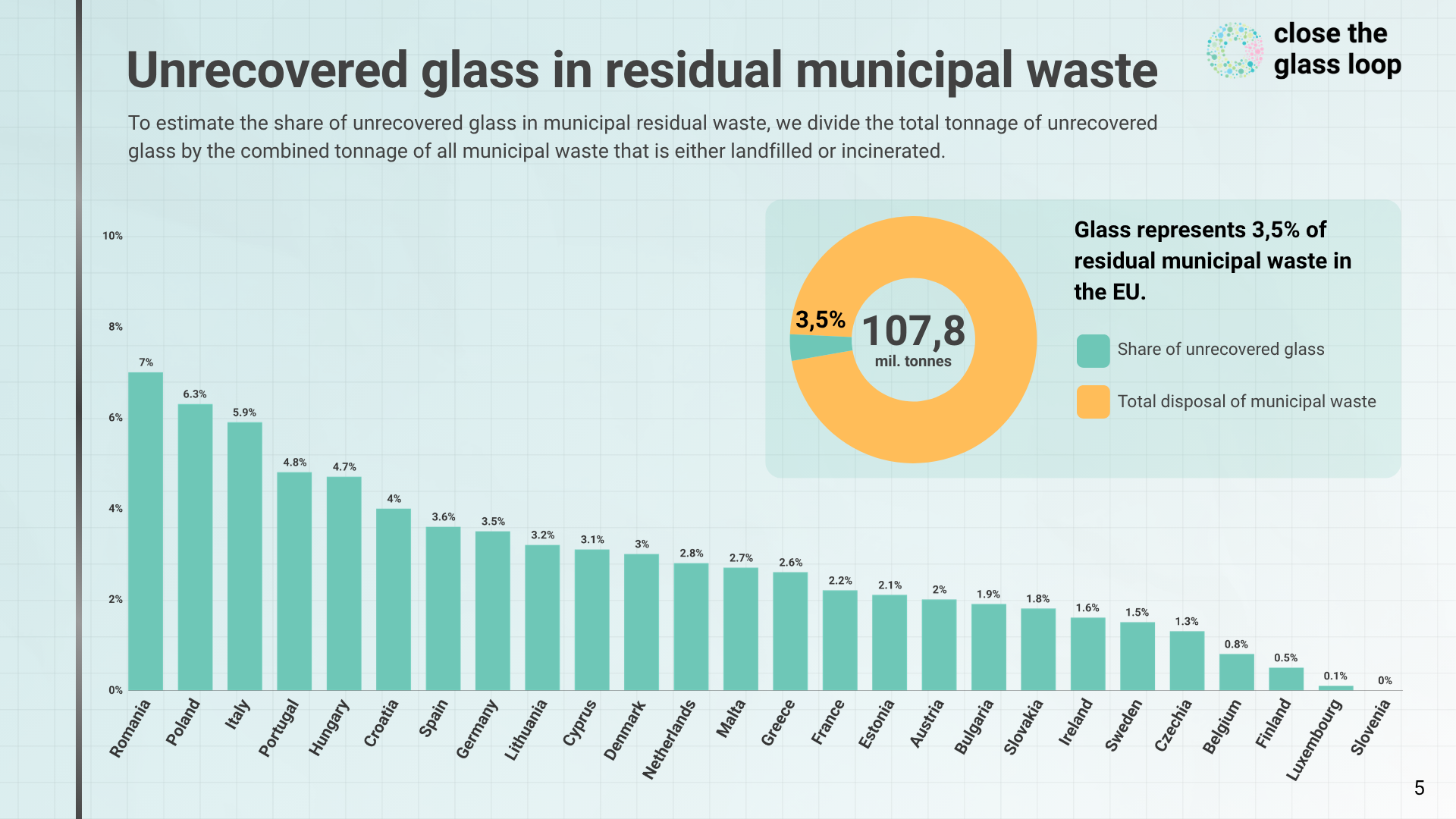
Against this total, unrecovered glass packaging represents an estimated 3.5% of residual municipal waste.
The estimated share varies significantly among Member States. It reaches 7% in Romania, 6.3% in Poland and 5.9% in Italy, while several countries record considerably lower shares.
Where does unrecovered glass ultimately go?
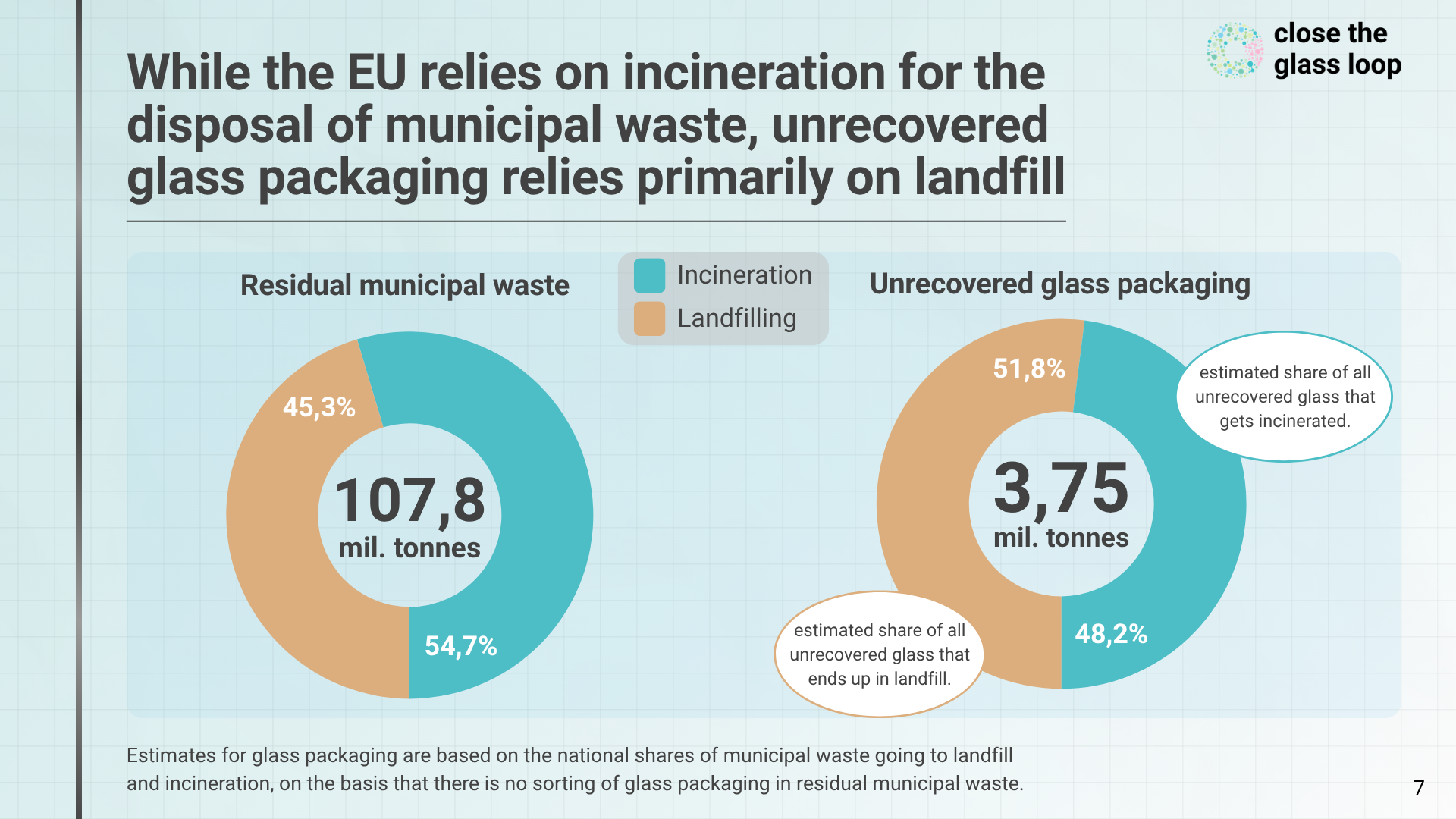
For municipal waste disposal overall, the EU relies slightly more on incineration than landfill. Approximately 54.7% of municipal waste sent to disposal is incinerated, while 45.3% is landfilled.
For unrecovered glass packaging, however, the study estimates a different pattern.
51.8%
Approximately 1.9 million tonnes of unrecovered glass packaging are estimated to end up in landfill.
48.2%
Approximately 1.8 million tonnes of unrecovered glass packaging are estimated to go to incineration.
The study also estimates that unrecovered glass packaging accounts for 3.9% of residual waste sent to landfill, compared with 3.0% of residual waste sent for incineration at EU level.
National waste strategies produce different outcomes
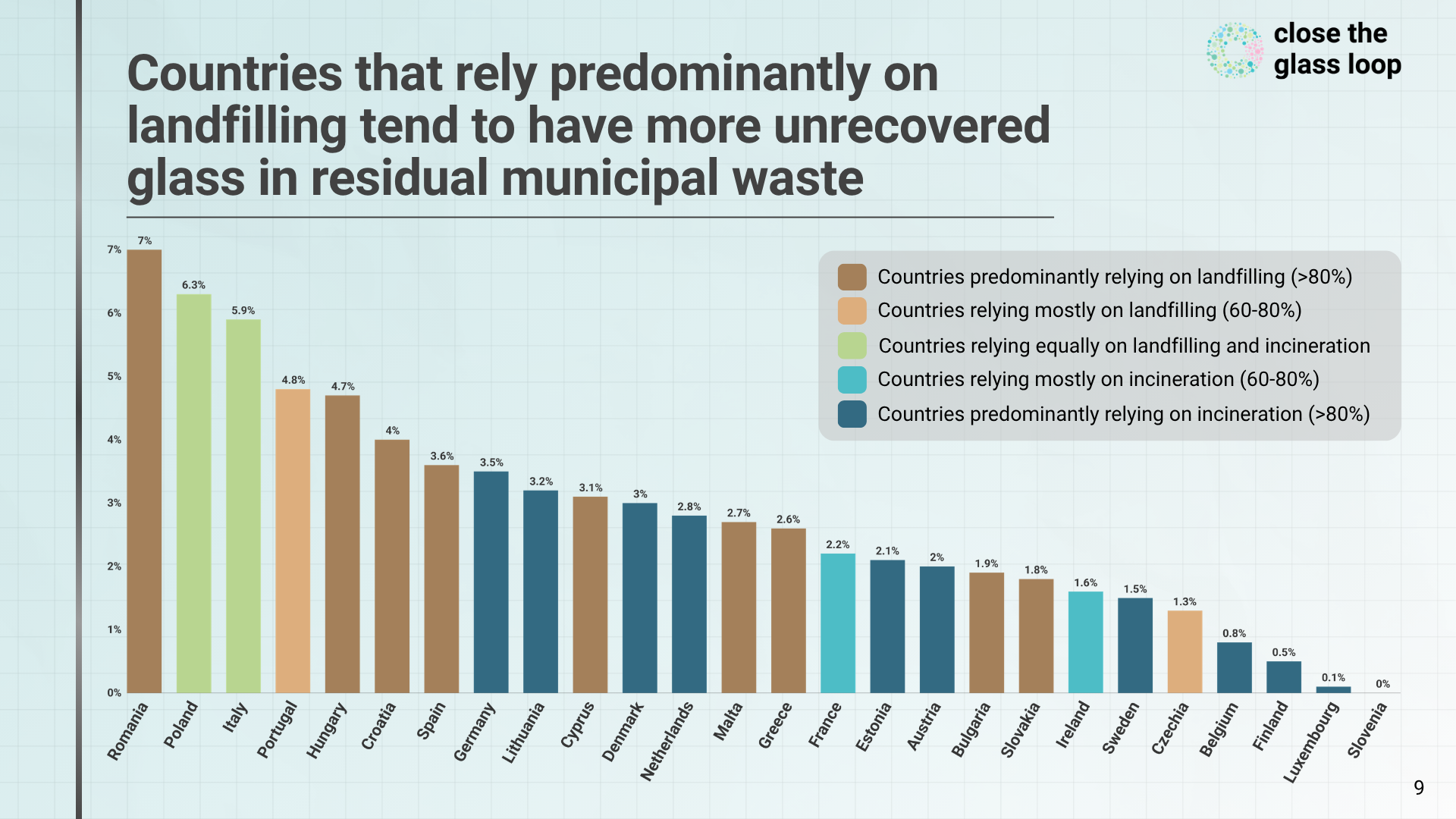
How unrecovered glass packaging is ultimately treated depends significantly on each country’s municipal waste disposal strategy.
Some Member States, including Belgium, Finland, Estonia, Sweden and Germany, rely predominantly on incineration. Others, including Romania, Bulgaria, Cyprus, Malta, Croatia and Greece, send a much larger share of municipal waste to landfill.
Better recycling performance helps keep glass out of residual waste
The analysis identifies an overall relationship between glass packaging recycling performance and the amount of glass remaining in residual waste.
In general, countries with stronger glass packaging recycling rates have a lower estimated share of unrecovered glass in residual municipal waste, although there are exceptions to this pattern.
This relationship highlights the importance of effective collection systems. Capturing glass packaging through dedicated collection before it enters residual waste gives the material the opportunity to return to the production cycle as recycled glass.
The key finding: Once glass packaging enters residual municipal waste, opportunities to recover it and return it to the closed loop are extremely limited.
Keeping glass in the loop
Glass is a permanent material that can be recycled repeatedly in a closed loop when it is collected and processed correctly. When glass packaging is not captured through dedicated collection and instead enters residual waste, that circular potential is lost.
The findings therefore reinforce the importance of preventing glass from entering residual waste in the first place. Improving collection coverage, making collection convenient for citizens, providing clear sorting instructions and maintaining the quality of collected glass can all support stronger recycling performance.
Close the Glass Loop continues to bring together partners across the glass packaging value chain to improve collection, increase recycling and ensure that more glass remains in a closed material loop.
Explore the full study
Discover the complete EU analysis, country comparisons and methodology in the Close the Glass Loop study
What happens to unrecovered glass in residual waste?