
2 April 2025
Crushing Glass for Better Recycling: Key Insights and Considerations | Federico Salvati, Sibelco
This is the presentation of Federico Salvati from Sibelco in the Ep14 of #90MinutesCGL, discussing challenges in glass crushing and its impact on recycling. He explained that contamination in glass recycling is concentrated in coarse fractions, where large contaminants are easier to remove, while smaller fractions contain thousands of tiny infusible pieces that reduce sorting efficiency.
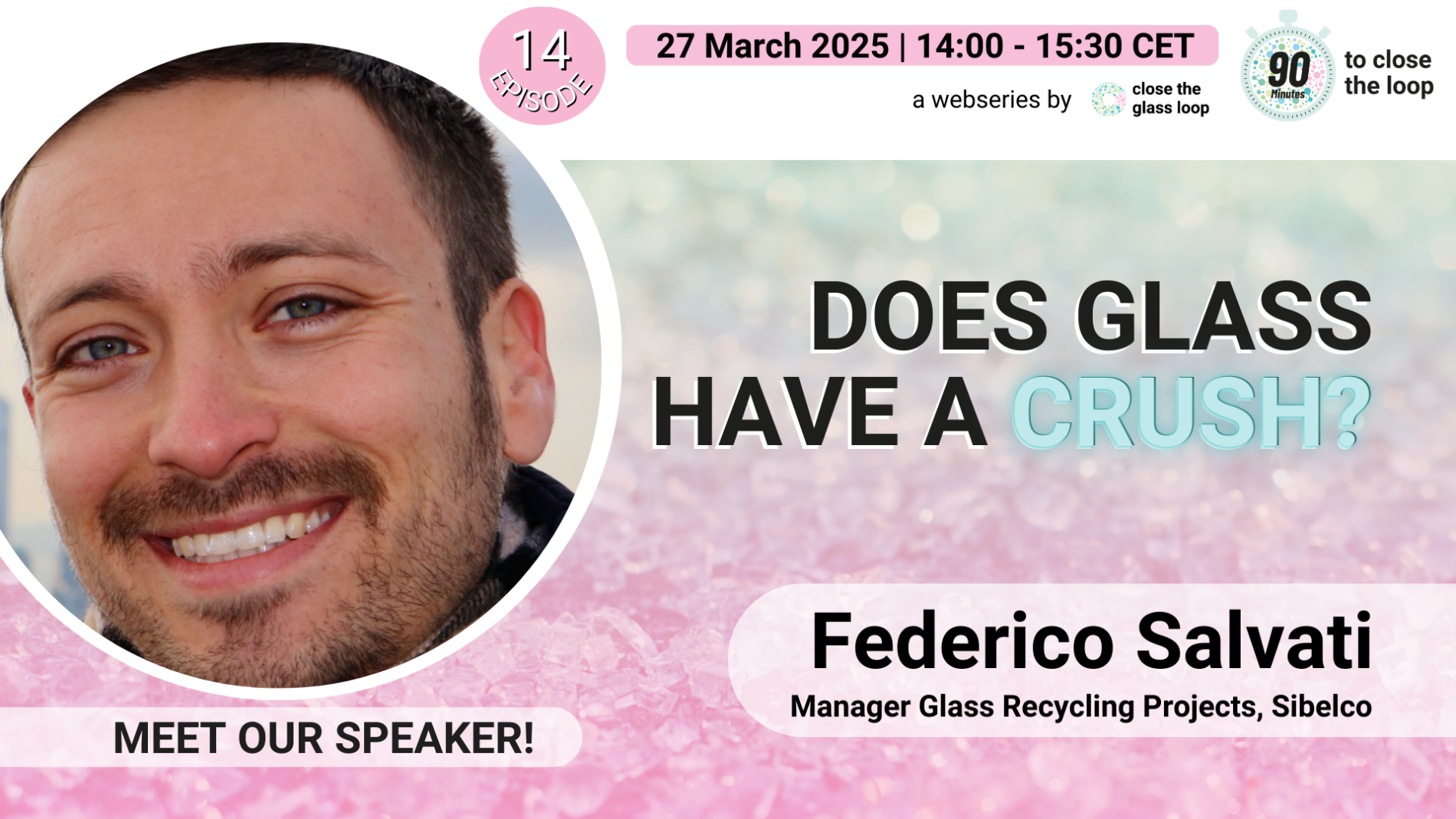
Optical sorting machines perform well with larger glass pieces but struggle with finer fractions, requiring multiple sorting steps to achieve high purity. Crushing glass before reaching recycling facilities must be controlled, as indiscriminate crushing increases fine particles, making sorting and recovery more difficult. Proper calibration of crushing equipment ensures recyclability by balancing fragment size—avoiding overly coarse or excessively fine glass. Indiscriminate crushing, such as with compactors or shredders, leads to higher glass losses and lower recycling rates. While crushing optimizes transport and storage, excessive fines lower material value and make sorting more costly. Advanced optical sorting machines can detect small contaminants, but sorting efficiency declines with finer particles, increasing costs and energy consumption. Removing contaminants like paper from fine glass fractions becomes especially difficult, as weight similarities reduce the effectiveness of air-based separation. Ultimately, increased fine particles in recycling plants raise capital and operational expenses while increasing glass loss, complicating efforts to maintain high recycling rates.
Watch Federico’s presentation here:
Did you miss the latest episode of 90 Minutes to Close the Loop? Catch up now on YouTube! Click the link to watch the full episode!