
28 November 2025
90 Minutes to Close the Loop, Episode 15
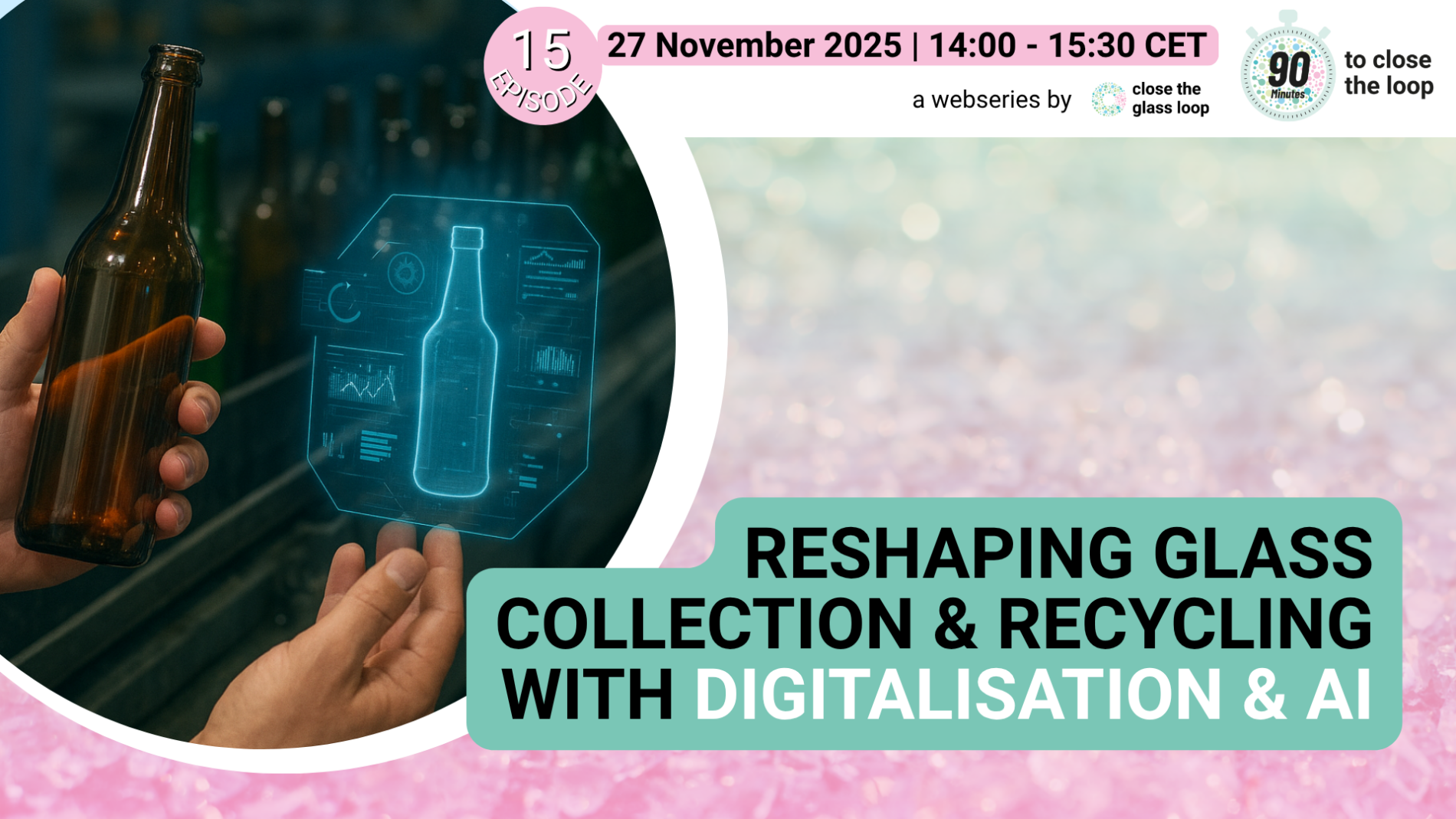
Digitalisation and artificial intelligence are rapidly redefining how Europe manages glass collection and recycling. Episode 15 of 90 Minutes to Close the Loop, held on 27 November 2025, explored how data, smart infrastructure and behavioural insights can help the value chain reach the EU’s ambition of 90% glass collection for recycling by 2030. Although glass is infinitely recyclable, collection performance and system efficiency vary widely across the continent. The episode highlighted how digital tools can close these gaps, improving logistics, reducing operational costs, identifying missing collection points, and ultimately shifting citizen behaviour.
Recycling Pilot Project in Croatia
A digital recycling pilot in Croatia tested whether digital communication, supported by AI-generated visuals, could improve glass recycling without changing physical infrastructure. Targeting confusion between the deposit-return scheme and bottle banks, the campaign used the Friends of Glass platform to clarify rules, reduce perceived effort, and strengthen social norms. Locally resonant AI visuals and the use of the iconic Podravka jar boosted engagement. Follow-up surveys showed fewer jars thrown into mixed waste, better understanding of sorting, and a stronger sense of personal responsibility. Collection data confirmed a positive trend compared to control cities, demonstrating that insight-driven communication can meaningfully shift behaviour, while also exposing structural barriers that require system-level fixes.
Smart Bins and Acoustic Recognition
Smart-bin technology using acoustic material recognition was deployed to gather real-time data at the point of disposal and link it to citizen participation through NFC or app identification. A city implementation in Meliana showed rapid results: nearly 40% household participation, over 100,000 recorded recycling actions, and a 28% increase in glass collection, with almost 100% purity. The system enabled targeted incentives through local rewards and produced granular data for optimising container use, identifying high-activity zones, and improving logistics. Expansion plans include full-city coverage, filling-level sensors, and pay-as-you-throw models built on behavioural and demographic data, illustrating how real-time disposal intelligence can increase both capture rates and operational efficiency.
Full-Chain Data Integration in Austria
A nationwide digital platform, Digido, provides real-time data sharing across the entire glass value chain, connecting collectors, transfer stations, recyclers and municipalities. It automates documentation, improves transparency, integrates rail cargo data, and reduces errors in transport records. Additional tools like the “Glass Future” app standardise assessments of container condition and site cleanliness, enabling faster repairs and higher-quality collection points. The system also supports filling-level evaluation, automated share calculations for municipalities, and potential route optimisation. While Austria’s long-established collection system limits large cost savings, digital tools strengthen traceability, coordination and service quality across a highly mature collection network.
AI-Driven Collection Optimisation in Spain
AI models were developed and implemented by Ecovidrio to help Spain meet rising collection targets by forecasting container filling levels, clustering bins based on efficiency criteria, and recommending optimised collection schedules. Using decades of operational data plus socio-economic variables, the system predicts when and where glass will accumulate, allowing collection partners to reduce unnecessary trips, prevent overflows and free capacity for deploying thousands of new containers each year. Early modelling indicates potential efficiency gains between 7% and 20%, translating into significant cost control, higher service quality for municipalities, and more resilient scaling as collection targets increase toward 2030.
As Europe pushes toward its 2030 targets, data-driven solutions will be essential not just to collect more glass, but to collect it smarter, faster and at a lower environmental cost.
The Speakers Lineup:
🔹 Michael Delle Selve, Head of Marketing & Communications, FEVE – the European Container Glass Federation
🔹 Gonzalo De Sebastián, Director of Strategy & Innovation, Ecovidrio
🔹 Eva Koller, Managing Director, Austria Glas Recycling GmbH
🔹 Jordi Berguinzo Martínez, Chief Strategy Officer & Co-Founder, Candam Tech
And if you missed the episode, you can watch it here and speaker presentations are below the video:
